Is Europe ready for the European Health Data Space?
The European Health Data Space (EHDS) Regulation is one of the most ambitious health data initiatives ever launched in Europe. From 2029 onwards, its enforcement will fundamentally change how health data is shared for patient care, research, innovation and public policy. The Regulation defines the legal framework for sharing health data within the common Eupropean health data space, but it leaves Member States free to determine how interoperable, reusable and trustworthy data are generated. Based on extensive analysis and real-world testing, the AIDAVA project raises a critical question: can the health data space itself be implemented at scale, affordably, and fairly across Europe?
What does EHDS scaling mean for hospitals?
As major healthcare providers and health data holders, hospitals will play a central role in EHDS implementation. Depending on their role within the national implementation framework, they will increasingly need to:
- capture and manage health data in interoperable electronic health record systems;
- support the exchange of the EHDS priority data categories through national implementations of the European Electronic Health Record Exchange Format (EEHRxF);
- contribute to the provision of high-quality data for authorised secondary use;
- document datasets and support national data governance arrangements where designated as health data holders;
- respond to authorised requests for secondary use through the national Health Data Access Body arrangements.
As both producers and consumers of clinical information, hospitals have a strong interest in improving data quality and semantic interoperability at the point of capture, since investments supporting secondary use also enhance the quality, continuity and safety of patient care. Their central challenge is to generate and maintain interoperable clinical data in a scalable, sustainable and economically viable manner.
Why data quality and interoperability are still broken?
European health data is rich, but it is not ready. Across hospitals and healthcare systems:
- Data is fragmented across many systems (EHRs, lab systems, imaging, pharmacy, legacy databases)
- Around 80% of health data is unstructured or semi-structured text
- Documentation of data sources is often incomplete or outdated
- Redundancies, inconsistencies, and errors are common
- The same standards (FHIR, SNOMED, LOINC, ICD) are implemented differently across countries and vendors
As a result, health data cannot be reused without extensive manual curation. Today, interoperability is largely reactive: data is cleaned, mapped, and transformed only when needed, often from scratch.
This approach does not scale to EHDS-level requirements and makes reliable data reuse slow, expensive, and error-prone.
Why cost and maturity differ across countries
EHDS assumes a level of digital maturity that does not exist evenly across Europe.
Some Member States operate centralized health data infrastructures with strong semantic standards and national governance. Others rely on fragmented hospital systems, limited interoperability, and scarce technical expertise.
AIDAVA’s analysis shows that:
- Digital maturity varies significantly across Member States
- Countries with centralized systems are better positioned to meet EHDS requirements
- Hospitals in lower-maturity systems face higher costs and longer timelines
- Technical connectivity (e.g. MyHealth@EU) does not guarantee semantic interoperability
This means that the same EHDS obligations can cost different amounts, depending on national context and hospital type. Without targeted support and automation, compliance risks becoming disproportionately expensive for less mature systems.
Why this risks a digital health divide
If EHDS implementation follows current approaches, Europe risks creating a two-speed health data space where some hospitals struggle to comply or delay participation.
- Data quality and availability will differ across regions
- Patients may receive uneven quality of care across borders (because of uneven data quality)
- Research and AI models will rely on potentially biased or incomplete datasets
- Innovation will concentrate on countries where data is already strong
Rather than reducing inequalities, EHDS could unintentionally amplify existing digital and health disparities between countries, regions, and healthcare providers, going against the fundamental principles of the EU of (digital and heal) equity and inclusion.
How AIDAVA’s digital twin approach changes the equation
AIDAVA proposes a different foundation for EHDS implementation, orchestrating a set of AI (and non-AI) tools to semi-automatically generate and maintain a high-quality, interoperable and reusable digital twin of the health record of each individual patient. This digital twin is stored within each patient Personal Health Knowledge Graph (PHKG), created and stored locally within each data holder.
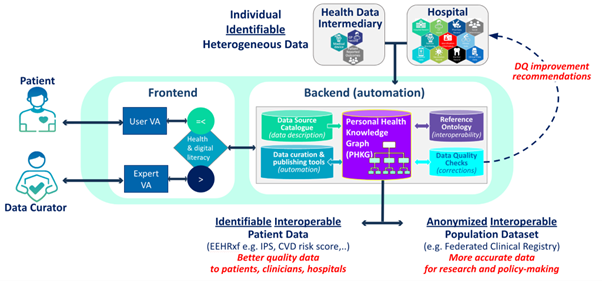
AIDAVA:
- Extracts heterogeneous data from hospitals and from health data intermediaries collecting non-hospital data
- Harmonizes this heterogenous data available in variable formats (paper, electronic, structured, semi-structured, narrative, images) and standards (LOINC, ICD, SNOMED, HL7,..) into a single interoperable format, the PHKG, compliant with the AIDAVA reference ontology
- Detects and corrects inconsistencies and redundancies on the PHKG by triggering data quality checks and therefore ensuring data quality by design
- Publishes data automatically in different format from a single PHKG (identifiable data, including the EHDS critical data categories in EEHRxF) or from multiple PHKG (anonymous data for clinical registries)
This approach shifts interoperability from a manual task done just-in-time and repeated many times whenever data is needed, to a one-time, proactive process supporting any output (with automated publishing tools). Indeed once the digital twin is in place within an hospitals:
- Data quality labels become easier to maintain
- Data becomes immediately reusable for care, research, and AI including
- Automatic generation of EHDS compliance data such as critical categories in EEHRxF
- Smooth extraction and transformation - without any curation - of data across all relevant hospital running a PHKG, in answer to a HDAB query
Crucially, this reduces costs, limits the need for specialized skills, and makes EHDS compliance more realistic for hospitals across Europe, regardless of their starting point.
Why this matters now
EHDS is not just a regulation.It is infrastructure and, if successful, it can boost quality of care in EU while decreasing its cost. Whether it succeeds or fails depends on whether Europe can move from fragmented, manual data handling to (AI) automated, high-quality interoperability at scale.
AIDAVA’s work shows that this transition is possible — but only if implementation realities are addressed early, openly, and collectively.
The AIDAVA project Policy Brief and its accompanying Technical Evidence Paper, draw on four stakeholder roundtables held with patients, hospitals, decision-makers and industry and they examine how the European Health Data Space (EHDS) can be implemented in a scalable and economically sustainable manner. They argue that while the EHDS establishes the legal framework for the exchange and reuse of health data, achieving its full potential will require approaches that improve semantic interoperability and data quality at the point of care. The Policy Brief presents the key strategic messages and recommendations for policy makers, while the Technical Evidence Paper provides the underlying analysis, engineering model and stakeholder evidence that informed these recommendations. spending on data preparation, and the reasoning supporting the "curate once, use many times" paradigm.
Download the documents:
Cost models (presentation available on demand - please contact us)